Accurate gas detection is essential for maintaining safety and compliance in industrial, laboratory, and environmental settings. Over time, even the most advanced sensors can drift from their original calibration, leading to inaccurate readings. That’s why regular calibration is not just recommended—it’s necessary.
At Gas Sensing, we offer comprehensive calibration services tailored to the specific requirements of the sensors and manufacturers we support. Our team ensures that your equipment remains reliable and in line with the most current industry standards.
Why Calibration Matters
All gas sensors degrade over time due to environmental exposure, sensor aging, and usage conditions. Annual calibration ensures that:
- Readings remain accurate and consistent
- Safety thresholds are properly enforced
- Equipment continues to meet manufacturer specifications
- Regulatory compliance is maintained
Calibration Frequency: What We Recommend
While most manufacturers recommend annual calibration, the ideal schedule can vary depending on your application and sensor type. Here’s a general guideline we advise:
- Monthly – Perform a bump test to confirm sensor responsiveness
- Every 6 Months – Conduct a field calibration or send your device for inspection
- Annually – Schedule a factory calibration or sensor replacement
This schedule helps minimize downtime, maximize performance, and ensure accurate readings when it matters most.
Common Sensors That Need Calibration
We provide calibration services for a variety of gas sensors including (but not limited to):
- Ozone (O₃) Sensors
- Electrochemical Gas Sensors
- UV Ozone Analyzers
- Hydrogen Peroxide (H₂O₂) and Peracetic Acid (PAA) Sensors
- Particulate Matter Sensors (PM)
- HMOS-based sensors
- And many others
Calibration Costs (Estimate)
Our calibration fees vary depending on the type of sensor. Here’s a general breakdown:
- In-house Calibration (electrochemical/HMOS sensors): $150
- 2B Technologies 106 Series Analyzer: $300 (includes $192.50 service kit)
- 2B Technologies 306 Calibration: $1200
- GENie O₃ Calibration: $265
- Aeroqual PM Sensor (HotSwap/Calibration): $550
- ATI Sensors (H₂O₂ and PAA): $205
Note: Prices are subject to change based on labor and parts.
The RMA Process
To send your sensor for calibration, please follow these steps:
- Fill out the RMA form provided on our website.
- Print and include the form inside the shipping box with your sensor.
- Send the package to our facility.
- We’ll notify you upon arrival and follow up after evaluation/calibration.
- Payment is processed after calibration is complete.
Important: Sensors that fail calibration will not be returned due to liability concerns. Questions? Contact us at rma@gas-sensing.com.
Our Calibration Equipment: NIST Traceability
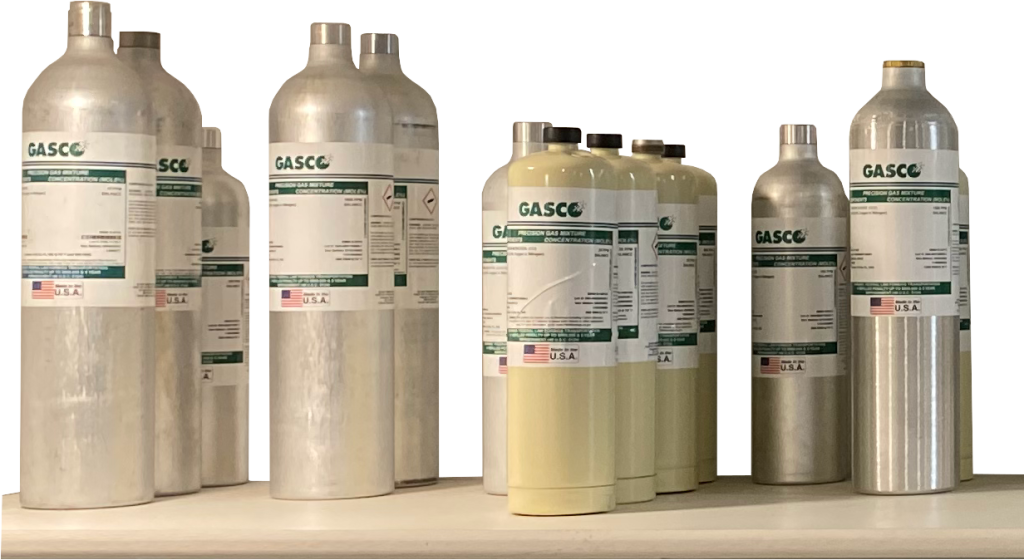
All our calibration equipment and gases are NIST traceable, ensuring the highest accuracy standards.
The National Institute of Standards and Technology (NIST) sets the benchmark for all measurements in the U.S. Your sensor’s calibration certificate must clearly state that it was calibrated against a NIST-traceable standard. If needed, we can provide documentation verifying this traceability.
Calibration Certificates
Every calibration includes a calibration certificate documenting:
- The calibration date
- The due date for the next calibration
- The NIST-traceable standard used
- Sensor and device serial numbers
- Calibration gas concentrations used
Keep this certificate on file—it’s your assurance of accuracy and your proof of compliance.
Field Calibration Services
Field calibration is ideal when sensors are deployed in hard-to-access or remote locations. Using portable calibration gases or generators, our technicians (or yours) can calibrate sensors without removing them from service.
Gas Sensing also offers on-site calibration services to help you minimize disruption and keep your operations running smoothly.
Bump Testing: Quick Sensor Verification
A bump test is a simple way to verify that your gas sensor is responding properly. It involves exposing the sensor to a known gas and checking for a response—ideal for quick checks between calibrations.
While bump testing is not a substitute for calibration, it’s an important safety measure.
Some systems, like the ATI D12 and F12 monitors, support automated bump testing via Auto-Test generators that run scheduled tests and trigger alarms if sensors fail to respond.
Supported Calibration Procedures
We provide calibration instructions and support for a variety of devices:
- How to calibrate an Aeroqual Sensor
- How to calibrate an ATI Sensor
- How to calibrate an EcoSensor Device
Visit our support resources or contact us directly for step-by-step guidance.
Trust Gas Sensing for Expert Calibration
From simple ozone sensors to advanced particulate analyzers, we help keep your equipment accurate, compliant, and safe. With NIST-traceable equipment, industry expertise, and responsive service, Gas Sensing is your trusted partner in gas detection.
Ready to schedule a calibration or have questions?
Contact us today or fill out the RMA form to get started.
Would you like this content repurposed into a downloadable brochure or service sheet as well?